TL;DR
Kadence terms changed on May 12, 2026. Site caps now apply to new customers. Legacy unlimited licenses remain only as long as subscriptions stay active. Plan migration away from Kadence now.
What Changed: Kadence Themes Terms of Service Shift
If you built your site on Kadence and believed you owned the license outright, you need to understand what changed on February 1, 2025. Kadence themes’ terms of service were replaced by Liquid Web’s Master Service Agreement, shifting Kadence from independent software to a rented service. This change carries consequences for your costs, your flexibility, and your ability to dispute terms.
The change was not announced with urgency or detail. Instead, Liquid Web sent two affiliate emails on May 12, 2026, positioning the consolidation as an opportunity. If you are using Kadence today, your transition status depends on when your current subscription renews. If you are evaluating Kadence for a new site, the terms you will accept are fundamentally different from what Kadence offered before.
This article explains what actually changed in the Kadence themes terms of service, why it matters in business terms, and what it means for your next decision about Kadence.
The Terms Changed Twice
Until November 2021, Kadence operated under an End-User License Agreement. Section 6 of that agreement granted you a “non-exclusive, nontransferable license to use the Kadence Software…for your internal purposes only.” The license was perpetual. You owned the right to use what you paid for. Kadence could not revoke your license without cause, and termination simply ended your access going forward. You kept one copy for archival purposes.
That agreement survived through at least early 2025. Business owners could purchase an unlimited-sites license and know it would remain theirs, subject to the terms they agreed to at the time of purchase.
On February 1, 2025, Kadence discontinued the unlimited-sites license for new customers. New pricing introduced hard caps: 3 sites, 10 sites, 25 sites, or 1,000 sites, each at different price tiers. More significantly, the license agreement was replaced by Liquid Web’s Master Service Agreement. Kadence is no longer software you license. It is a service you subscribe to.
The distinction is not semantic. Under a service agreement, the vendor retains control over what the service is, how it operates, and when it can be withdrawn. A service agreement is a rental. A license agreement is a purchase with defined boundaries.
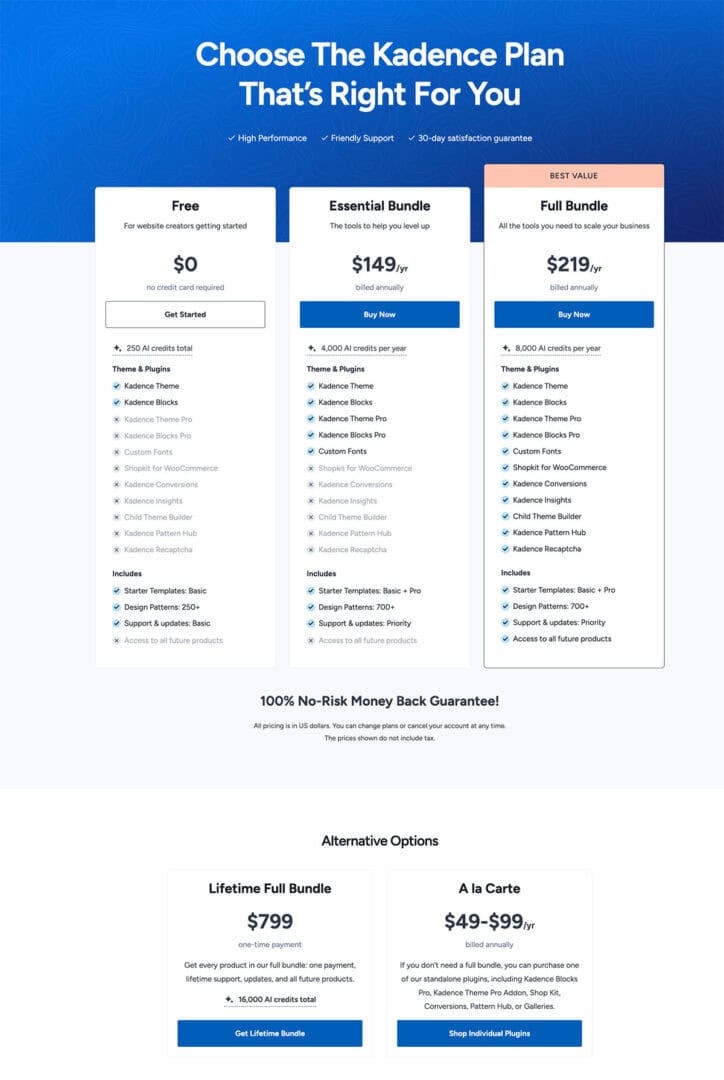
Kadence introduced site caps in the new subscription model. The previous unlimited-site license is no longer available to new customers.
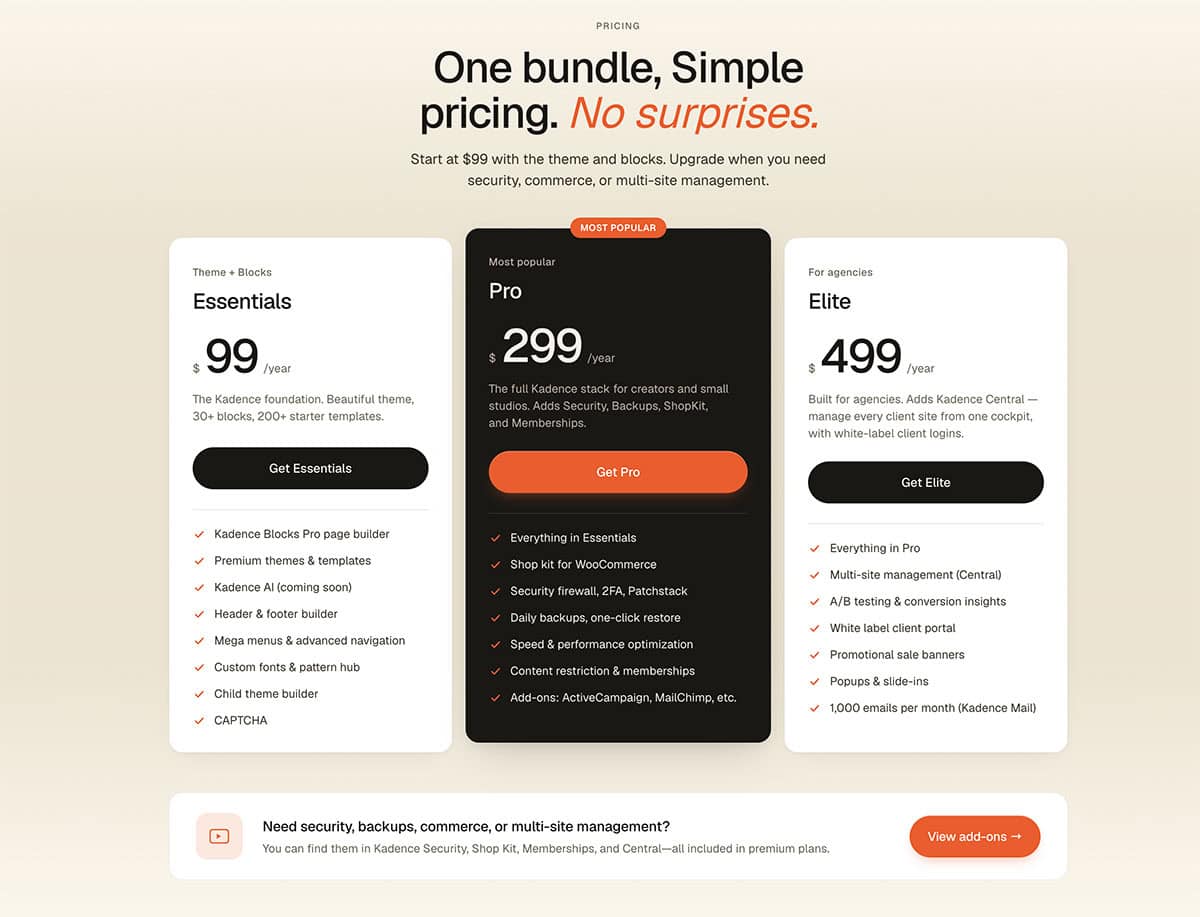
The old Kadence EULA (November 2021) allowed you to keep one copy of the software for archival purposes after termination. The new Liquid Web TOS (May 2024) grants no such right. Upon termination, all access is lost immediately.
What the Service Agreement Says
The Liquid Web Master Service Agreement that now governs Kadence contains provisions that diverge sharply from the legacy license.
Automatic Renewal and Site Caps
Section 8 of the Liquid Web TOS states that your subscription will automatically renew and your payment method will be automatically charged for each renewal period, “unless either party provides the other party with written notice of its intention not to renew at least thirty (30) days before expiration of the current Term.” If you miss that window, your subscription renews. If a payment fails due to an expired card, a billing address update, or a dispute, your subscription lapses. The new TOS does not preserve legacy unlimited status during lapses or account suspensions.
The pricing structure now forces a choice: pay more per site or operate with fewer sites. An agency that previously paid a flat rate for unlimited sites now faces scaling costs as projects grow.
Suspension and Data Destruction
Section 8 also includes a provision that should concern any business owner: “During the suspension period, we shall have the right to deny access to, and/or, destroy data stored on the compromised server or account.”
This language grants Liquid Web unilateral authority to destroy your data. The trigger is broad: “we determine that the Services are being used…in breach of this Agreement” or “we reasonably believe that the Services have been accessed…in any way by a third party without your consent.” Liquid Web does not specify what constitutes a breach that warrants destruction. It does not require proof of actual harm. It requires only reasonable belief.
The old Kadence EULA contained no equivalent provision. Termination ended your rights, but it did not authorize the destruction of your data.
The Liquid Web TOS allows data destruction during account suspension without a clear appeals process. If Liquid Web believes your account has been compromised, they can delete your data before you have a chance to respond.
Class-Action Waiver and Mandatory Arbitration
Section 11 of the Liquid Web TOS requires arbitration for all disputes and bans class actions. The language is explicit: “WHETHER YOU CHOOSE ARBITRATION OR SMALL-CLAIMS COURT, YOU MAY NOT UNDER ANY CIRCUMSTANCES COMMENCE OR MAINTAIN AGAINST US ANY CLASS ACTION, CLASS ARBITRATION, OR OTHER REPRESENTATIVE ACTION OR PROCEEDING.”
This means you cannot join other Kadence users in a lawsuit if a widespread problem affects multiple customers. You cannot pursue a claim through court; you must arbitrate with Liquid Web. You cannot recover legal fees unless the arbitrator awards them. You have surrendered your right to judicial review.
The old Kadence EULA did not include arbitration language. It was governed by the laws of England and Wales (or Delaware if you contracted directly with Kadence Inc.). Disputes could be litigated in court.
Pricing Changes at Liquid Web’s Discretion
The shift from Kadence’s independent EULA to Liquid Web’s Master Service Agreement carries a structural consequence that extends beyond pricing. By reclassifying Kadence as a “Service” rather than licensed software, Liquid Web gains the authority to suspend or modify your design tools based on hosting-level policies that have nothing to do with the theme itself.
Section 8 of the Liquid Web TOS allows suspension of “Services” if Liquid Web determines a breach has occurred. “Services” in this agreement encompass the entire Liquid Web hosting ecosystem, not just Kadence. This means a hosting-level policy violation, a server compromise, or a dispute with Liquid Web about your account could suspend your access to Kadence design tools, even if Kadence itself has no issue with how you are using it.
You are no longer a customer licensing a standalone design tool. You are a subscriber to infrastructure that Liquid Web controls at every layer: hosting, backup, security, and now your design layer. This consolidation gives Liquid Web leverage to bundle policies and enforce them across all services simultaneously. If your hosting account is flagged, your Kadence access stops. If your Liquid Web account is disputed, your design work becomes inaccessible.
The practical consequence is that your design tool is now subject to policies you did not agree to when you purchased Kadence, and those policies can change without warning. Your site’s design layer is no longer independent. It is subordinate to the hosting company’s infrastructure decisions.
Why This Matters in Business Terms
The shift from software ownership to service subscription affects three areas where business owners need predictability.
Cost Predictability
Under the old model, you paid once for unlimited sites. Your cost was fixed. Growth did not increase your software expense. Under the new model, each additional site beyond your tier cap triggers a cost. An agency managing 50 sites under an old unlimited license now pays significantly more. An agency managing 500 sites may need to move to the 1,000-site tier, which costs substantially more than the previous tier beneath it.
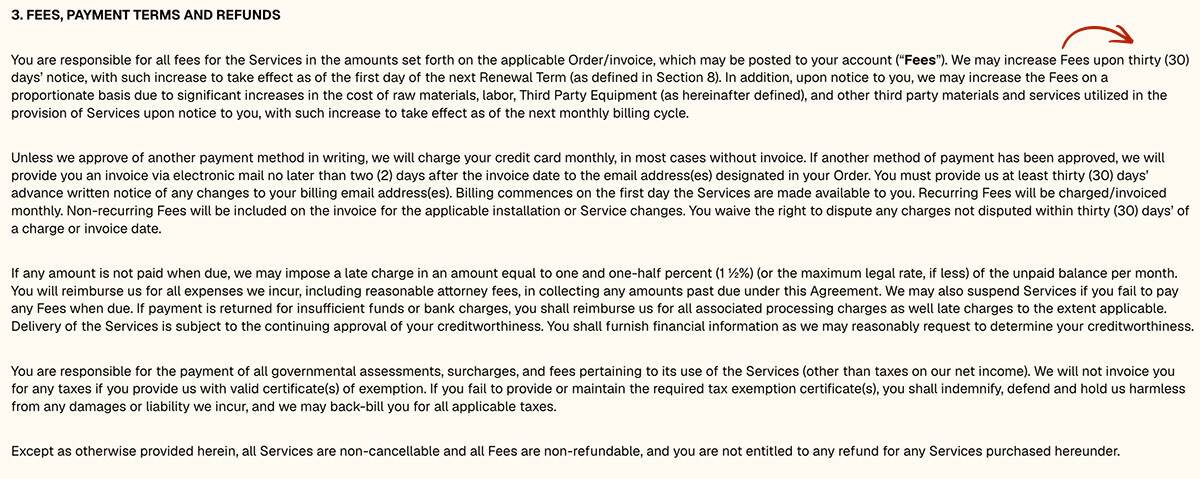
Liquid Web can also increase the base price of each tier on 30 days’ notice. There is no obligation for the increase to reflect actual cost changes. It reflects only Liquid Web’s decision that costs have risen significantly.
Access Stability
The old Kadence model did not give the vendor a unilateral right to suspend or terminate your license based on an interpretation of what constitutes a breach. The new Liquid Web model allows suspension if they “reasonably believe” there is an issue. The bar is low. The remedy is swift. Your data can be destroyed during the suspension, before you have a chance to appeal.
A failed payment, a billing update delay, a card expiration, or an account-compromise alert triggers a suspension risk. Missing a 30-day renewal notice deadline by a few days means losing your unlimited license permanently, even if you have been a customer for years.
Ownership and Control
The most significant shift is psychological and legal. Under the old model, Kadence was a tool you owned. You licensed the software, and within the scope of the license, it was yours to use. Under the new model, Kadence is an infrastructure you rent from Liquid Web. You do not own it. You cannot transfer it. You cannot export it in a way that preserves your custom designs and data without significant friction. You have access only as long as Liquid Web allows, under terms that can change on 30 days’ notice.
This distinction matters if Liquid Web decides to exit the Kadence business, discontinue the product, change the interface, or raise prices to unsustainable levels. You have no recourse other than arbitration against Liquid Web itself.
Liquid Web has already consolidated four standalone WordPress products (SolidWP, Iconic, Restrict Content Pro, and MemberDash) into Kadence and LearnDash. Features from those products are now built into the larger platforms. Existing customers retain access but cannot use new features without upgrading to the full plan. This pattern suggests further consolidation and feature reorganization is possible.
The Legacy Unlimited License
If you purchased Kadence before February 2025 under the old license, you still have unlimited sites. But that status is fragile.
Liquid Web’s official statement on legacy customers comes from their announcement about consolidating multiple products into the new Kadence suite. According to their blog post “A New Era for WordPress,” Liquid Web states: “Existing users will keep their plans, their features, and their pricing. We’re changing how RCP is packaged and sold moving forward, not how it works for our existing customers.” This language is reassuring on the surface. However, there is an important distinction: you keep your *existing* features, but you do not automatically receive *new* features added to higher tiers.
If you’re on the legacy Essentials tier and Liquid Web releases a new advanced block next month, you probably won’t have access to it unless you upgrade to Pro or Elite. This creates a subtle pressure to upgrade—the longer you stay on an older tier, the wider the feature gap becomes. The bigger concern, however, is that your access to these features depends on maintaining an active and uninterrupted subscription. A failed payment, a missed renewal deadline, or a billing issue can trigger permanent loss of your legacy unlimited status.
Your legacy status persists “provided your subscription remains active and uninterrupted.” This language creates a fragile dependency. A failed credit card payment, a temporary hold from your bank, a billing address update that doesn’t process cleanly, or a missed email notification is no longer a minor administrative inconvenience. Any of these events, lasting even one billing cycle, permanently revokes your unlimited status.
This is not a bureaucratic technicality. This is a structural point of failure designed to catch you. If your subscription lapses for 24 hours—not because you chose to cancel, but because a payment bounced or a card expired—Liquid Web terminates your legacy license. You cannot recover it. You then fall into the new tiered system with hard site caps, and you will pay significantly more to regain the same functionality you already owned.
The Liquid Web TOS does not specify a grace period for payment lapses or a mechanism to restore legacy status after a temporary suspension. The language is absolute: your subscription must remain “active and uninterrupted.” The moment it is interrupted, for any reason, your legacy rights are gone. This creates a risk that extends beyond Liquid Web’s actions. Your own payment processing, your bank’s systems, and your email management now determine whether you keep the license you purchased years ago.
For agencies and business owners managing multiple subscriptions and payment methods, this is a critical vulnerability. A single administrative mistake or a bank processing error can trigger permanent loss of your unlimited license. Unlike traditional software licensing, where termination is a deliberate action, this system terminates your rights automatically if a routine payment fails. It is a system optimized to reclaim legacy customer equity at the moment of an administrative lapse.
The Transition Date Matters
Liquid Web sent the announcement on May 12, 2026, but the change took effect on February 1, 2025. This means customers whose subscriptions renewed at any time between February and May faced different terms without explicit notice. The announcement came after the change was already in place.
Customers renewing after May 12, 2026, will be subject to the new terms. Customers whose subscriptions renew in 2027 will be making a choice with full knowledge of what the change means. By April 2027, Liquid Web will stop releasing updates to Kadence 1.x. Customers will have the option to stay on the last 1.x build or upgrade to a new plan to get 2.x updates.
This timeline creates pressure to migrate before Kadence enters maintenance-only status. At that point, you are paying for a product that no longer receives new features, security patches, or bug fixes. Your only option is to upgrade or move to another platform.
What This Means for Your Next Decision
If you are a current Kadence user, the change does not force you to migrate immediately. Your existing license (or your legacy unlimited status, if you have it) remains valid as long as you maintain active, uninterrupted subscription payments. But the clock is running. By April 2027, Kadence 1.x will no longer receive updates.
If you are evaluating Kadence for a new site, you are now evaluating a Liquid Web service, not an independent software product. You would be committing to a vendor-controlled platform with hard site caps, automatic renewals, data destruction clauses, and no recourse outside arbitration. You would be paying recurring subscription fees for what you thought might be a one-time investment in a tool.
The prudent path is to plan for migration now, while Kadence continues to receive updates and your sites remain operational. Waiting until April 2027 means migrating a product in maintenance mode, with no new features or security fixes. Waiting until a breaking change or a price increase forces your hand means migrating under pressure.
The first step is to audit your Kadence usage: which blocks you use, which design patterns are essential to your site, and which custom CSS or integrations exist. Document what Kadence does for you right now. Then, over the next 11 months, evaluate alternatives that do those things and plan the transition. By April 2027, you will be ready to move, not scrambling to adapt.
Kadence was a trustworthy tool because it was independently owned software. Liquid Web has converted it into a service. The terms, the pricing, and the control now rest with Liquid Web. It is time to plan for life after Kadence.
What is the difference between owning a software license and using a service?
A software license grants you the right to use a product under defined terms. You own the license. A service is the infrastructure that the vendor operates and controls. You rent access to it. The vendor can change the service, suspend your access, or destroy your data during that subscription. You have no ownership stake.
If I have a legacy unlimited Kadence license, will I keep it forever?
You will keep your unlimited status only as long as your subscription remains active and uninterrupted. If a payment fails, you miss a 30-day renewal deadline, or your account is suspended, you permanently lose legacy status. You would then fall into the new tiered system with site caps. There is no mechanism to recover the unlimited status once lost.
Can Liquid Web really destroy my data without my permission?
Yes. Section 8 of the Liquid Web TOS allows Liquid Web to “deny access to, and/or, destroy data stored on the compromised server or account” during a suspension. They define a compromised account broadly as one they “reasonably believe” has been accessed by a third party without consent. There is no appeals process specified before destruction.
Will Kadence stop receiving updates in April 2027?
Yes. Liquid Web announced that Kadence 1.x will no longer receive updates after April 2027. Customers will have the option to stay on the final 1.x build without updates or upgrade to Kadence 2.x to receive ongoing support. Staying on 1.x means no new security patches, bug fixes, or features.
What happens if I do not renew my Kadence subscription before the 30-day deadline?
If you do not provide written notice of non-renewal at least 30 days before your subscription expires, the subscription automatically renews, and your payment method is automatically charged. If the charge fails, your subscription lapses and you lose access to Kadence immediately. If you had legacy unlimited status, it is lost permanently.
Does my unlimited Kadence license still work?
Yes, as long as the subscription remains uninterrupted; however, reclassification as a ‘Service’ changes the underlying legal protections.
Assess Your SaaS Vulnerability
Download the Architectural Risk Assessment. Evaluate your exposure to SaaS vendor lock-in and create a migration plan before costs or control become the problem.