The SaaS Hostage Crisis: A Clinical Analysis of the Digital Tenant Model
You didn’t build a business on software. You built it inside software. The distinction is the entire problem and the reason your most valuable operational assets are sitting in someone else’s building.
At some point in the last decade, the software industry quietly changed the deal. The tools you adopted to build your business stopped being tools and started being the building itself. Nobody announced this transition. The invoices kept coming, the interfaces kept updating, and the operational gravity of each platform grew heavier until the day you tried to leave and couldn’t. That is the SaaS hostage crisis, and it did not begin with any single platform. It is structural.
This is not a critique of software. Software is one of the most powerful levers a small business has ever had access to. The problem is not the technology. The problem is ownership. Specifically, the systematic dismantling of it. The modern SaaS model operates on a simple architectural premise: the more deeply a business embeds a platform into its operations, the less it can afford to make independent decisions. That dependency is not a side effect of the product. In most cases, it is the product.
Call it what it is. When a platform holds your customer data, your automation logic, your course content, your transaction history, or your email list inside an architecture you cannot export cleanly, you are not a subscriber. You are a hostage with a monthly invoice.
The SaaS hostage crisis and the structural failure of rented land
Every generation of business owners learns this lesson in a different context. The farmers who built their operations on land they didn’t own discovered their vulnerability when the landlord raised the rent or sold the estate.
The retailers who built their customer acquisition entirely on a single platform discovered it when the algorithm changed. The app developers who built their entire business inside a marketplace discovered it when Apple or Google changed the fee structure on a Tuesday morning with four weeks’ notice.
The SaaS version of this lesson follows the same structural logic. You do not own your position on rented land. You rent it. And the landlord, regardless of how friendly the interface looks or how much the support team apologizes, is optimizing for their cap table, not your continuity.
The architects of these platforms understand the economics precisely. Customer acquisition is expensive. Retention is cheap. The cheapest form of retention is a product so deeply embedded in a customer’s operations that the switching cost makes leaving economically irrational, even when the platform’s behavior has become predatory. This is not an accident of product design.
It is the strategy.
The moment you cannot leave a platform without destroying something you built, that platform owns you. It acquired you without a term sheet, without a board vote, and without your informed consent.
Documenting the SaaS hostage crisis in the risk archive
The following cases are not aberrations. They represent a pattern, a predictable behavioral cycle that activates once a platform has achieved sufficient market penetration and investor pressure to extract more revenue from its existing base. National competition regulators are now formally investigating the SaaS hostage crisis as a market failure, focusing specifically on how vendors engineer structural vendor lock-in.
The technical term in private equity is “monetizing the installed base.” The operational term for the business owner on the receiving end is a crisis.
The Risk Archive Documented Platform Pivots
| Platform | The pivot | Dependency held hostage | Risk class |
|---|---|---|---|
| ActiveCampaign | Read-only access to automation logic upon cancellation | Workflow architecture | Critical |
| Mailchimp | Charged subscribers for undeliverable and unsubscribed contacts | Email list economics | Critical |
| Teachable | Added transaction fees retroactively to existing paid plans | Course revenue margin | Critical |
| Mighty Networks | Reclassified standard features as premium to force upgrades | Community workflows | High |
| Gumroad | Replaced sliding-scale fees with a flat 10% rate overnight | Unit economics | Critical |
| CoSchedule | Froze "lifetime" users on unmaintained product while charging 500% premium for current version | Editorial operations | High |
Each entry in this archive shares a common anatomy.
First, the platform achieves critical mass with a loyal user base.
Second, growth plateaus or investor timelines accelerate.
Third, the platform restructures its pricing or access model to extract additional revenue from users who are already operationally embedded.
Fourth, those users face a binary choice: absorb the new cost, or absorb the switching cost.
In most cases, neither option existed twelve months earlier. The platform manufactured both the problem and the only exits from it.
The lock-in is not a bug. It is load-bearing architecture.
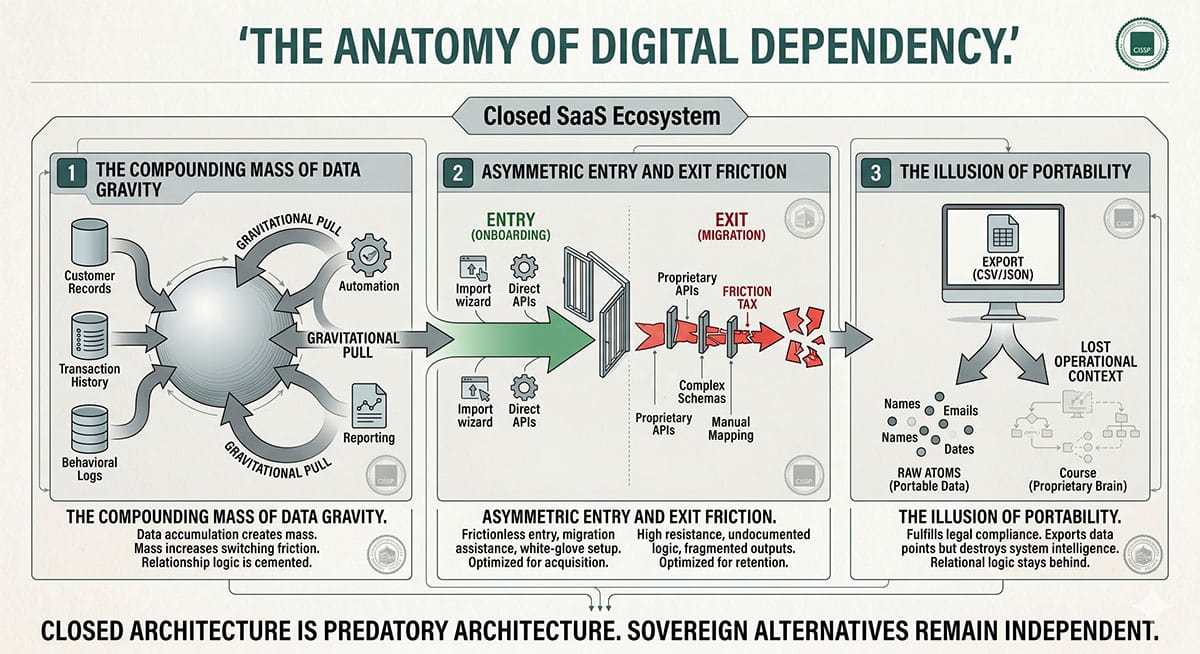
To understand why the SaaS hostage crisis is so difficult to exit, you need to understand how the trap is physically built. It does not rely on malice in the product team. It relies on three structural mechanics that compound quietly over the lifetime of your subscription, each one making the next more expensive to unwind.
The first mechanic is data gravity. Every record your business generates inside a platform. Every contact, transaction, behavioral event, and configuration state adds mass to the system. Mass creates gravitational pull. The larger the dataset, the more operationally expensive it becomes to move it, because data rarely migrates cleanly across architectural boundaries. Field names don’t match. Relationship structures don’t translate. Custom objects built inside one platform’s schema have no equivalent in the next. What looks like an export button is usually a CSV file that contains your data but destroys its architecture. You get the atoms. You lose the molecule.
The second mechanic is entry and exit asymmetry. Every platform you have ever adopted made onboarding frictionless by design. Import wizards, migration assistants, white-glove setup calls. The industry has invested heavily in lowering the cost of entry because acquisition is the metric that drives valuation. Exit receives no equivalent investment, because a frictionless exit is a platform’s least profitable feature. The result is a one-way valve: getting in takes an afternoon, getting out takes a quarter. This asymmetry is not accidental. It is the architecture of retention.
The third mechanic is the illusion of portability. Most platforms offer data export as a compliance gesture rather than a functional capability. They satisfy the legal requirement to provide access to your data while ensuring that the exported format requires significant engineering work to make operational anywhere else. Your contacts export as a flat file. Your automation logic exports as a proprietary format no other system reads. Your course content exports without its enrollment relationships, completion states, or payment history. The data leaves. The operational context stays. What you recover is raw material, not a functioning system, and rebuilding the system from raw material is the switching cost the platform already calculated when it set your subscription price.
The Read-Only Logic Ransom
Upon cancellation, ActiveCampaign reverts user accounts to read-only access. The automation sequences you engineered (the conditional logic, the behavioral triggers, the segmentation rules) remain visible but inoperable and non-exportable in any meaningful architectural format.
You can see what you built. You cannot take it with you. The platform has, in effect, retained your intellectual work product as collateral against your departure.
This is not a technical limitation. It is a deliberate architectural choice that converts your own operational investment into a retention mechanism for them.
How the SaaS hostage crisis defines the modern business model
When Gumroad announced its fee restructuring, it did not describe the change as a revenue extraction event. It framed it as a simplification. When Mailchimp charged for cleaned contacts, it did not describe the billing logic as a structural tax on good list hygiene. It described it as standard practice. When CoSchedule sold lifetime access plans, it did not disclose that lifetime would be operationalized as the lifetime of a product version they intended to stop developing.
The language of these announcements is always pastoral. The mechanics are always extractive.
This gap between framing and function is where the real risk lives. A business owner who reads a pricing update email and interprets it charitably as a reasonable adjustment to market conditions misses the structural signal: this platform has decided that your switching cost is high enough to absorb a forced repricing. They ran the numbers. They know how much your dependency is worth. This email is not a communication. It is a conclusion they already reached in a board meeting.
The reason this cycle repeats across platforms is architectural. SaaS businesses build moats through data lock-in, workflow dependency, and integration complexity. The same features that make a platform genuinely useful also make it genuinely dangerous to leave.
Every hour your team spends building within a platform increases the switching cost. The platform’s product roadmap and your operational depth grow together, which means the platform’s leverage over you increases in proportion to how much you’ve invested in it. Loyalty and dependency are, in this context, the same variable.
Every feature you build inside their walls is a brick in a building you don’t own. The more beautiful the interior, the more expensive the exit.
Sovereign infrastructure is not an ideology. It is an accounting position.
The phrase “sovereign infrastructure” describes a specific architectural posture: your core operational assets live on systems you own, control, and can migrate independently of any vendor’s business decisions. This is not a philosophical position about the nature of software freedom. It is a risk management framework with a calculable return on investment.
Consider the math that business owners almost never run. A platform with $300 per month in fees sounds trivial until you calculate what a forced migration actually costs: the engineering hours to export and re-import data, the rebuilding of automation logic, the retraining of a team, the revenue disruption during transition, and the opportunity cost of six to twelve weeks of infrastructure work that generates no new business.
The platforms know this math. They price their hostage situations accordingly. Most of their subscribers never run the calculation, which is exactly why the model works.
The sovereign alternative does not require abandoning modern software. It requires making a categorical distinction between the tools you use and the systems you depend on.
A design tool is a tool. Your customer database is a strategic asset. A scheduling utility is a tool. Your email list and the automation logic that operates on it are strategic assets. Strategic assets belong on infrastructure you control.
The architectural objective is simple. Eliminate the possibility of a SaaS hostage crisis before the platform has the leverage to initiate one.
The four categories of digital asset that demand sovereign architecture
1: Your customer and contact data
Every name, email address, behavioral event, purchase history, and segmentation tag that your business has earned through marketing, sales, or service belongs in a database your company owns outright.
The moment this data lives exclusively inside a SaaS platform, you have transferred your most valuable commercial asset to a third party and accepted their terms of service as the governing document of your relationship with your own customers. This is categorically unacceptable for any business serious about continuity.
2: Your automation and operational logic
The conditional rules, behavioral sequences, and workflow architecture your business has developed to operate at scale represent months or years of systems thinking. This logic is intellectual property. It documents how your business runs.
Storing it exclusively inside a platform’s proprietary automation builder means your operational knowledge base is subject to that platform’s pricing model, feature roadmap, and terms of service. The ActiveCampaign case is the clearest illustration of where that leads: your own thinking, locked behind a wall you no longer control.
3: Your content and course architecture
If you build a curriculum inside a hosted course platform, you have not built a product. You have built a product inside someone else’s product. The content itself may be portable, but the student experience, the enrollment data, the completion rates, the community context, and the commercial relationships that the platform mediates are not yours to take cleanly.
Teachable’s transaction fee pivot demonstrated what happens when the platform decides your course revenue is a resource they have decided to share in, without your agreement and after you’ve already built your business model around their original terms.
4: Your transaction and revenue infrastructure
Any platform that sits between your business and your customers’ payments holds structural leverage over your revenue. The Gumroad fee restructuring made this explicit overnight: a platform that once positioned itself as a low-friction payment layer revealed itself as a 10% stakeholder in every transaction you process through it.
Sovereign transaction infrastructure means your payment processing, your revenue data, and your commercial relationships flow through systems where the fee structure is a contract you negotiated, not a policy announcement in your inbox.
The migration threshold is lower than your current switching cost
The most common objection to sovereign infrastructure is the build cost. Engineers cost money. Self-hosted systems require maintenance. The stack you’d need to replace a modern SaaS platform sounds prohibitively complex from the outside. This objection is real but almost always overstated, because it compares the full theoretical cost of a sovereign build against the current convenience of a running SaaS subscription, rather than against the actual cost of a forced migration after a platform pivot.
The architecture required to own your customer database, host your own email infrastructure, and maintain your operational logic is not equivalent to rebuilding Salesforce from scratch. It is a deliberate, scoped system design using open-source tooling that has matured significantly in the last five years. n8n, Supabase, Listmonk, Ghost, and self-hosted versions of tools that previously required expensive managed subscriptions now make sovereign infrastructure accessible to a business with a single technical person on staff or a part-time infrastructure architect on retainer.
The relevant question is not whether you can afford to build sovereign infrastructure. The relevant question is whether you can afford not to, given what you now know about how platforms behave once they’ve achieved sufficient lock-in. The Risk Archive is not a list of cautionary tales. It is a predictive model. Every platform in that table once had a user base that trusted it the way you currently trust yours.
This is not a coincidence. This is a business model.
Lock-in is not a failure of product design. It is the design. The tools that become most useful become most dangerous precisely because of their utility. Usefulness creates dependency. Dependency creates leverage. Leverage creates a pricing event.
This cycle has repeated across every category of business software, in every market, at every price point. The variable that determines when the pivot happens is not the platform’s character, it is the platform’s capitalization timeline and the elasticity calculation on how much their installed base will absorb before the churn rate becomes a problem.
You are not a user. You are an architect with a property problem.
The frame shift that sovereign infrastructure demands is not technical. It is conceptual. A user asks “which tool solves my problem?” An architect asks, “Which assets does my business need to own, and which functions can I safely rent?” These are different questions with fundamentally different answers and fundamentally different risk profiles.
The business owner who approaches their software stack as an architect makes decisions with a different time horizon. They are not optimizing for the cheapest monthly fee or the most polished interface. They are designing a system that will still function — and still belong to them — regardless of what any individual vendor decides next quarter. They distinguish between the operational convenience of a rented tool and the strategic necessity of an owned asset. They run the migration math before they need it, not after.
The platforms you currently depend on will not send you a warning before they change the deal. They will send you an email with a subject line like “Important updates to your plan” and a tone designed to minimize churn. By the time that email arrives, the decision is made, the terms are set, and your switching cost is already the price of your freedom. The only moment you have real leverage in that relationship is before the dependency deepens — not after it has already been monetized.
This manifesto is the beginning of a longer conversation about what it means to build a business on infrastructure you actually own. The specific tools, the architectural decisions, the migration frameworks, and the technical stack that makes sovereign infrastructure practical for a non-enterprise operator are documented in the resources below. The first step is the conceptual one: recognizing that the hostage crisis is not an emergency that might happen to you someday. For the majority of business owners running on a SaaS-dependent stack, it has already begun. The only question is whether you are the last one in the room to understand the terms of your captivity.
Your Business is a Digital Tenant
Download the Architectural Risk Assessment by William Beem, CISSP. Identify the structural failures of the SaaS Hostage Crisis and begin your extraction