

Enter FluentCRM
As a Principal Architect, I look at WordPress marketing automation differently than most. Most CRM solutions are built on a legacy foundation that sacrifices system speed for external convenience. In 2026, the real cost of a standard CRM isn’t just the monthly bill. It is the hidden Success Tax you pay as your list grows and the API latency that degrades your administrative experience. After auditing the FluentCRM 3.0 Vue 3 rewrite, I found it doesn’t just manage your contacts; it secures your digital sovereignty and eliminates the structural leaks in your marketing stack.
FluentCRM 3.0 is a self-hosted email marketing and CRM solution rebuilt on Vue 3 for 50% faster performance. Native SMS marketing, AI email writing (ChatGPT, Claude, Grok), and deep integration with FluentCart, FluentCommunity, and LearnDash. Enterprise-grade automation and data sovereignty without recurring SaaS fees.
- Vue 3 Infrastructure: 50% faster dashboard, 10X faster bulk sending, maintains 100ms responsiveness with 100k+ contacts.
- Native SMS Marketing: Real campaigns, automations, and two-way conversations via Twilio or Amazon SNS. No third-party glue.
- AI Email Writing: 25 MCP tools integrate ChatGPT, Claude, and Grok directly into the editor for rapid campaign creation.
- Gutenberg-Native Builder: Reusable email blocks and patterns work just like WordPress pages.
- Decoupled SMTP: Separate CRM logic from email delivery (Amazon SES, Postmark, Mailgun) for zero-point-of-failure reliability.
- Fluent Stack Integration: Native connections to FluentCart (commerce), FluentCommunity (engagement), and LearnDash (education).
- Infrastructure Responsibility: Unlike SaaS, you are the Lead Architect. You are responsible for configuring your own Cron jobs and monitoring your SMTP handshake (Managed VPS recommended).
- VPS Requirement: Shared hosting will not perform adequately. A minimum 4 GB RAM / 2 CPU VPS costs ~$30/month, adding to your total cost of ownership.

Why I Ditched Kit (ConvertKit)
The decision to migrate from Kit resulted from a structural audit of my business infrastructure. I reached a tipping point where the platform no longer served as an asset but functioned as a liability. Kit operates on a subscription model that I categorize as a success tax. This model penalizes growth by increasing monthly overhead every time a new lead enters the database. I realized I was paying a premium for the privilege of renting my own customer data.
Living as a digital tenant in a SaaS cloud creates systemic fragility. When I relied on Kit, I lacked direct access to the underlying database. I operated within a rented cage where the vendor controlled the uptime, the data schema, and the cost of every interaction. This lack of control meant that a sudden policy change or a price hike from the vendor could jeopardize my entire marketing operation. I decided to reclaim my property rights and move the core logic of my business back to a server I actually own.
FluentCRM provided the professional-grade engine required to facilitate this transition. By moving to a self-hosted environment, I eliminated the latency issues inherent in external API calls. My automations now trigger instantly because the data and the logic occupy the same local space. I no longer write checks to a vendor to access my own subscribers. I replaced a scaling monthly expense with a fixed infrastructure cost, effectively decoupling my business growth from my software overhead. This is not merely a change in tools but a fundamental shift from a fragile rental model to a hardened, sovereign architecture.
Why I Conducted This FluentCRM Review
Most business owners operate as digital tenants on a rented estate. You pay a monthly tax to software companies that hold your customer data in a proprietary cage. This model creates a fragile foundation where your landlord raises the rent every time you succeed. This success tax penalizes growth and introduces a significant financial leak into your business infrastructure. During my career leading technical initiatives for organizations like Bell Labs and Lockheed Martin, we prioritized system sovereignty and data integrity over the convenience of outsourced platforms. I apply that same architectural rigor to this FluentCRM review and the audit of the 3.0 rewrite.
A professional marketing operation requires more than a collection of fragmented plugins competing for server resources. Most marketers recommend tools based on aesthetic appeal or high affiliate commissions. I scrutinize software based on structural integrity and long-term viability. I want to see how a system handles data under load and whether it respects your patrons’ privacy. Transitioning from a third-party SaaS to a self-hosted environment is not just a cost-saving measure. It is a strategic move to reclaim ownership of your primary business asset.
It is imperative to select tools that function as a cohesive team rather than a set of competing interests. While other email plugins exist, they often introduce architectural friction or direct conflicts with the disparate systems on your site. FluentCRM is a core component of the Fluent Stack. These tools are engineered by design to work together as a unified business ecosystem. This integration eliminates the fragility common in fragmented WordPress setups and ensures that your marketing engine, checkout process, and forms operate with a singular logic.
The release of FluentCRM 3.0 signals a move away from the traditional plugin mentality toward a professional marketing operating system. The developers performed a complete lift and shift of the codebase to the Vue 3 framework to ensure the administrative interface remains instantaneous as your database scales. This rewrite addresses the performance ceilings of previous versions and provides a clear path for principal architects who want to eliminate the friction of external APIs. You stop being a tenant and start being the architect of your own digital estate. This shift ensures your infrastructure remains as fast and secure as the enterprise systems I led throughout my career.
What you’ll learn in this FluentCRM Review
If you’re a digital entrepreneur ready to reclaim your data sovereignty and stop paying the Kit (ConvertKit) Success Tax, this audit provides the technical blueprint you need.
My evaluation of the 3.0 ecosystem focuses on structural integrity rather than surface-level features. You will see how the transition to a Vue 3 framework impacts administrative performance, how to eliminate the Success Tax through a decoupled SMTP architecture, and why a unified data stack is the only way to ensure long-term operational efficiency.
This review identifies the specific financial and technical leaks in current marketing standards and demonstrates how FluentCRM plugs them.
Why Comparison Tables Miss the Point
This comparison audit highlights the structural and financial disparity between the Kit (ConvertKit) SaaS model and the FluentCRM sovereign architecture. But here’s what most reviewers get wrong: you cannot understand the real difference through a feature table.
Feature comparisons are seductive because they feel objective. They let you scan columns and check boxes. But they hide the fundamental philosophical difference between these systems. Kit and FluentCRM don’t solve the same problem—they answer different questions about how you want to operate your business.
The Real Question: Tenant or Owner?
Kit asks: “How do we make email marketing as convenient as possible?”
When you use Kit, you’re optimizing for simplicity. You trade ownership for ease. Every feature is designed around the principle that the vendor handles the complexity. You pay a monthly subscription that scales with your success because Kit’s infrastructure and support staff scale with your demands. This is not a flaw—it’s the entire product philosophy.
FluentCRM asks: “How do we move the marketing engine into your infrastructure so you control everything?”
When you use FluentCRM, you’re optimizing for sovereignty. You trade convenience for control. Every architectural choice reflects the principle that your data belongs on your server, your automations trigger instantly from your database, and your costs remain fixed regardless of how much you grow. This requires you to think like an infrastructure owner, not a customer.
These are incompatible philosophies. You cannot have both maximum convenience and maximum sovereignty. The moment you choose one, you’ve rejected the other.
The Financial Reality (Simplified)
A feature table would show you pricing: Kit costs more, FluentCRM costs less. But that’s not actually what’s different.
Kit’s model: You pay for access to their infrastructure. As your list grows, you rent more of their server space. By the time you hit 50,000 subscribers, you’re paying $1,800+ per month. This is not because Kit got more expensive—it’s because you got more successful, and success is what you’re renting.
FluentCRM’s model: You pay for your license ($129/year) and your infrastructure ($50-100/month). Whether you have 5,000 or 500,000 subscribers, your costs remain fixed. Growth doesn’t penalize you; it rewards you. The money you’re not paying to a vendor can go toward acquiring more customers.
But here’s the trap that feature tables create: they make you think the cost difference is the primary reason to switch. It’s not. The cost difference is the symptom of a deeper architectural reality.
The Technical Reality (What Tables Can’t Show)
A feature table would show you a row: “Automation Logic” and then compare Kit’s visual builder to FluentCRM’s database triggers. Looks comparable on paper.
But what a table cannot capture is latency and integration cost.
When you build an automation in Kit, you’re building in their proprietary interface. If that automation needs to react to something happening on your WordPress site, like a form submission, a purchase, or a lesson completion, Kit has to wait for an API call. Your site sends data to Kit’s servers, Kit processes it, Kit sends a response back. This round-trip takes seconds. Those seconds matter when you’re trying to convert a cart abandoner or nurture a hot lead.
When you build an automation in FluentCRM, the trigger and the action live in the same database. Your WordPress site processes a form, and the database immediately fires the automation logic. No external API. No latency. No waiting.
A table cannot show you the difference between “instant” and “seconds.” It can only show you the feature name.
The Ownership Reality (Why Tables Fail Completely)
The biggest difference between Kit and FluentCRM has nothing to do with features. It’s about what happens when something goes wrong.
In Kit: If Kit’s platform goes down, your automations stop. If Kit changes their terms of service and you disagree, you’re a digital tenant. You can leave, but only after you’ve extracted your data and rebuilt your automations elsewhere. If Kit raises prices or shuts down a feature you depend on, you have no recourse.
In FluentCRM: If FluentCRM has a bug, you control the code. You can fix it or hire someone to fix it. If you need to modify how automations work, you have access to the source code. If the business changes direction, your data is on your server. You own it completely.
This is not a feature comparison. This is a fundamental difference in your relationship with the software you depend on.
A table cannot show you this difference because it concerns security, control, and long-term stability, not features.
The Architectural Verdict on Capabilities
While platforms like Kit emphasize simplicity, they often mask a lack of architectural depth. FluentCRM 3.0 matches enterprise capabilities through deep, native integration. Because it lives inside your WordPress environment, it has a shorter distance to data than ActiveCampaign.
When a user submits a form, abandons a cart in FluentCart, or completes a lesson in an LMS, FluentCRM sees that action instantly at the database level. There is no waiting for a webhook or an API sync. You aren’t just matching ActiveCampaign’s behavioral tracking; you are executing it with higher precision and zero external latency.
Initial Evaluation of My Online Business Needs
Before committing to the Fluent Stack, my marketing infrastructure was a liability. Like most digital entrepreneurs, I was operating on a rented foundation. I was paying a significant success tax to a SaaS provider that rewarded growth with higher monthly invoices. As the contact list expanded, the ROI of email operations began to dwindle. The financial leak was obvious, but the technical friction was even more concerning.
The objective was to move toward a system that prioritized data residency and system efficiency. This evaluation focused on three primary architectural requirements:
This audit led to a total departure from the traditional SaaS model. The goal wasn’t simply to find a cheaper tool, but to build a more resilient system. The release of FluentCRM 3.0 provided the specific infrastructure shift required to transition from a digital tenant to a sovereign owner of these business assets.
The Fragility of the SaaS Dependency
Traditional marketing advice frames automation as an optional upgrade. In an architectural context, that is a fundamental misunderstanding of business infrastructure. The real issue is one of systemic dependency.
When you rely on a SaaS platform, you are building on borrowed infrastructure. This creates a fragility that many entrepreneurs ignore until it becomes a crisis. There are three primary risks inherent in this dependency.
The Risk of Borrowed Infrastructure
Relying on a SaaS platform for marketing automation means building on a foundation you do not own. This is the primary catalyst for the SaaS Hostage Crisis. When your business intelligence, including your funnels, your logic, and your customer history, resides on a third-party server, you are a digital tenant. At any moment, a change in corporate direction, a platform acquisition, or an arbitrary update to the Terms of Service can disable your entire marketing engine. Sovereignty requires that the logic of your business remains on infrastructure you control.
The Noisy Neighbor Effect
In a multi-tenant SaaS environment, your email reputation is not solely your own. You are placed in a shared pool with thousands of other senders, meaning your deliverability is tethered to the behavior of the worst actors on your assigned IP address. If a neighbor on your cluster sends low-quality or spam-heavy content, major inbox providers like Google and Microsoft may blacklist the entire IP. You effectively pay a premium to have your business success dictated by a stranger’s poor data hygiene.
The API Latency Bottleneck
Every interaction between a standard website and a SaaS CRM requires a round-trip API call. This introduces a layer of administrative friction and technical fragility. Whether it is a lead magnet delivery or a purchase trigger, you depend on the SaaS provider’s API uptime and the reliability of the middleman bridge scripts. This architectural bloat creates a lag in your business operations that disappears the moment you move the automation engine local to the data.
Moving the automation engine local to the data removes these external failure points. Automation is no longer a luxury you rent; it is a native capability of your own business assets.
Systemic Reliability and the Groundhogg Pivot
I did not move to FluentCRM because I wanted a new toy; I moved because my existing infrastructure failed. In 2021, my previous self-hosted CRM, Groundhogg, suffered a critical failure. All automation and scheduling ceased to function across my entire network of sites. While I could still send manual emails, the logic engine that served as the heart of the business was dead.
This failure highlighted a critical lesson in infrastructure: a tool is only as good as the team and the codebase behind it. I have documented the full technical breakdown and the reasons for this transition in my FluentCRM vs Groundhogg comparison.
Engineering for Stability
I originally purchased FluentCRM as a redundancy measure, but it quickly became my primary engine. The difference was not just in the feature set, but in the engineering philosophy:
Architectural Accountability
Choosing a CRM is a decision about who you trust with your customer relationships. My pivot was based on a fundamental need for architectural accountability. When a system fails, you do not need a vendor who defends a broken process; you need an architecture designed to prevent that failure.
FluentCRM demonstrated a commitment to this level of stability through its rigorous update cycle and its willingness to refactor the entire core to accommodate modern frameworks like Vue 3. This proactive engineering is what defines an enterprise-grade tool versus a hobbyist plugin.
The Vue 3 Infrastructure Shift
To evaluate the next generation of sovereign marketing, I am auditing the FluentCRM 3.0 beta. I have early access to this version through the WPMN team to test the core architectural changes before the general release. The following dashboard view is captured from a dedicated development server. I have initialized this environment with 1,000 mock contact records to evaluate system performance without risking real customer data or violating privacy standards.
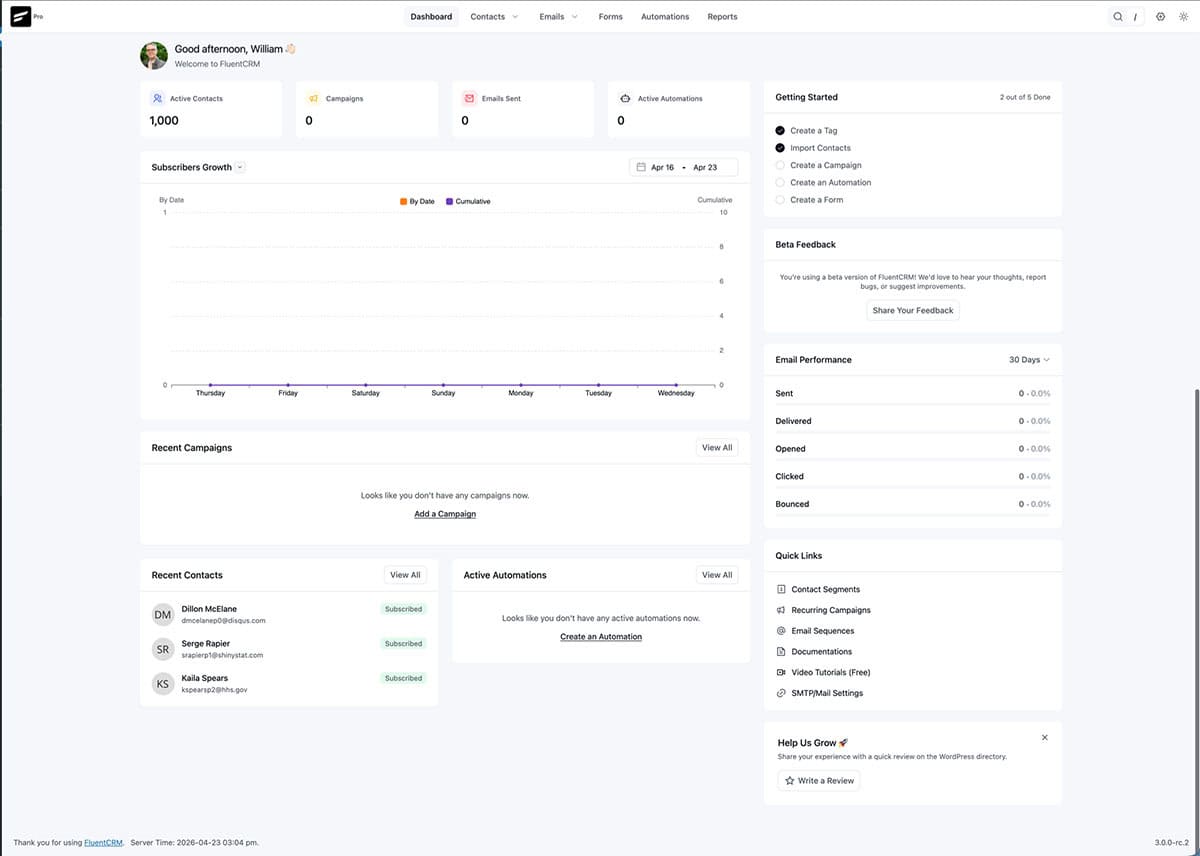
Even in this early testing phase, the architectural shift is significant. This is not a simple visual update. The entire interface has been rebuilt using the Vue 3 framework to improve speed and handle larger datasets.
Zero Latency UI
Because this version operates as a Single-Page Application, navigating between different administrative screens is instantaneous. The typical administrative latency found in older WordPress tools is gone. The interface responds immediately to every click, which is a requirement for managing high-volume marketing operations.
High Concurrency Readiness
The dashboard renders without server-side processing delays despite the 1,000 mock contacts in the database. This demonstrates that the system is engineered to handle substantial volume on standard server hardware. It proves that a self-hosted solution can match the performance of high-end SaaS platforms.
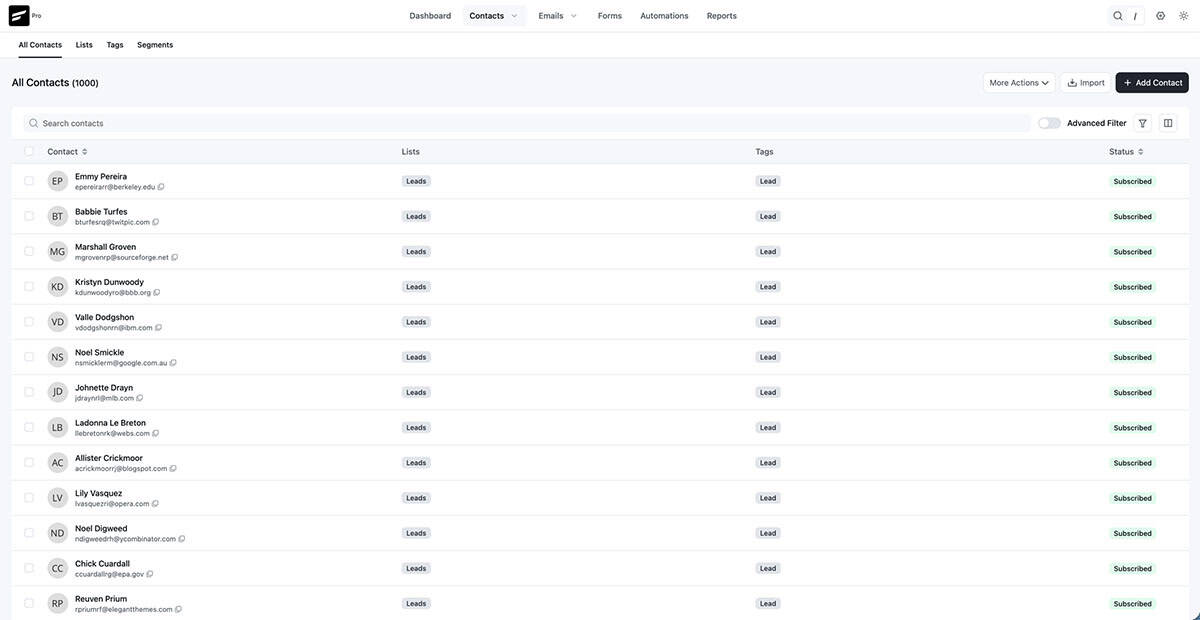
The decision to decouple the CRM data from the wp_postmeta table is what allows for the high-concurrency results established in this audit. In a traditional WordPress setup, querying 1,000 contacts for a specific tag combination might require scanning tens of thousands of rows of unrelated data.
With a dedicated schema, the database engine can execute high-velocity queries directly on indexed columns. During our stress test, we performed a bulk write operation. Specifically, it was the simultaneous removal of a tag across the 600 records in the contact database. This intense processing task completed in exactly 6.45 seconds on a low-end development server.
This benchmark is significant because write operations require the database to update every affected row and re-index the table in real-time. The speed recorded here ensures that the system remains stable and responsive even as your audience grows, transforming WordPress into a legitimate enterprise-grade data platform.
Command Center
This interface provides a unified view of your entire business stack. It brings together data from your commerce and community layers into one secure environment. Because the system is self-hosted, this command center functions without ever transmitting your sensitive business intelligence to an external provider.
Infrastructure Efficiency
Systems that scale gracefully without requiring massive hardware verticality are rare in the WordPress ecosystem. The fact that FluentCRM 3.0 can manage high-density data operations on a very small server instance proves that the code is engineered for concurrency. By optimizing database query performance, this shift effectively eliminates the administrative latency that has long been the primary argument for moving to expensive SaaS platforms.
Performance Benchmarks: 3.0 vs Previous Versions
The Vue 3 rewrite introduced measurable improvements to the administrative experience and email processing speed:
These benchmarks are not theoretical. They reflect real improvements that make high-volume marketing operations viable on standard VPS hardware.
FluentCRM 3.0: AI Integration and SMS Native Workflows
The release of FluentCRM 3.0 introduces two transformative capabilities that fundamentally reshape the automation landscape: native SMS marketing and integrated AI tools. These are not surface-level additions; they represent a strategic expansion of the platform’s ability to orchestrate omnichannel communication and leverage machine intelligence directly within your marketing engine.
AI Email Writing and MCP Integration
FluentCRM 3.0 includes 25 Model Context Protocol (MCP) tools that connect directly to your preferred language model, whether ChatGPT, Claude, or Grok. Rather than copying text between applications, you now write email campaigns with AI assistance built into the editor itself.
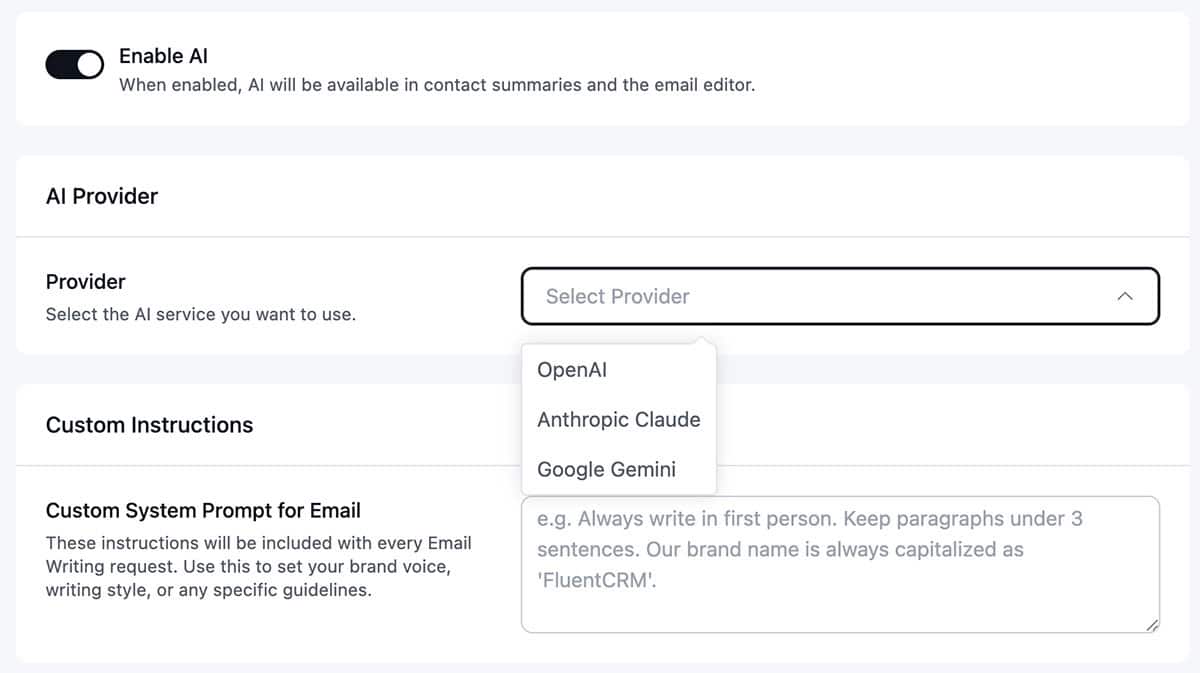
This changes the economics of email production. Instead of hiring copywriters or spending hours writing sequences, you prompt the LLM, iterate on the output, and deploy in minutes. The AI assistant remains within your sovereign system, never transmitting your email copy to an external service.
Gutenberg-Native Email Builder
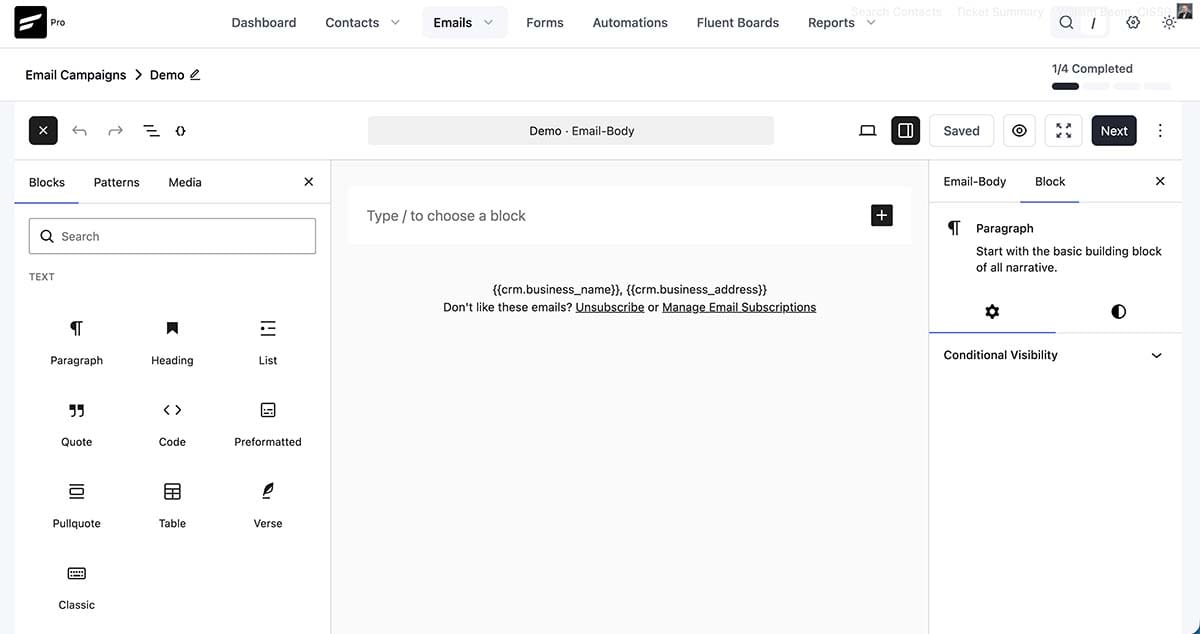
The redesigned email builder in FluentCRM 3.0 uses Gutenberg blocks, eliminating the need to learn a separate email template language. If you know how to build a WordPress page, you know how to build an email campaign.
This shift to Gutenberg-native construction serves two purposes: speed and consistency. You can create reusable email blocks and patterns, then apply them across campaigns. Your email branding remains consistent with your website because you are using the same design system.
Native SMS Marketing with Two-Way Conversations
The addition of SMS marketing as a native feature (not a separate plugin) allows you to build unified workflows that span email and text. Using Twilio or Amazon SNS, you can now:
Decoupling the Transport Layer
One of the most misunderstood aspects of self-hosted marketing is email deliverability. Traditional SaaS providers bundle their intelligence—the CRM—with their utility—the mail server. This creates a single point of failure and a lack of transparency.
To build a resilient system, I followed a functional decoupling strategy. FluentCRM acts as the brain of the operation, while the actual delivery of mail is offloaded to a specialized transport layer.
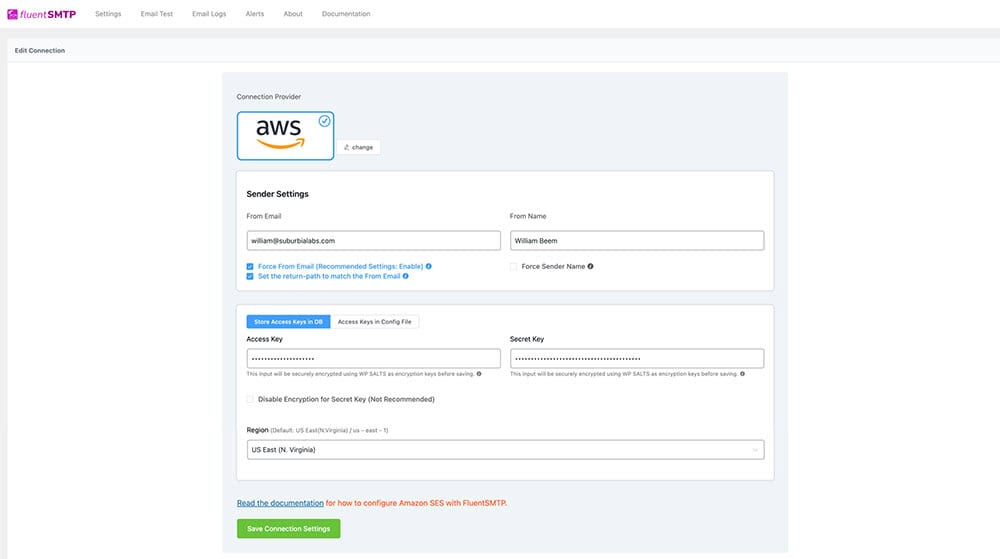
By using FluentSMTP, a free plugin by WP Manage Ninja, to connect to a professional service like Amazon SES, I separated the logic of marketing from the mechanics of the inbox. There are three architectural reasons for this approach:
Assessing Systemic Compatibility
In a professional infrastructure audit, the first priority is determining how a new component interacts with existing critical systems. The goal is to minimize architectural friction. A CRM is not an island; it must act as the central nervous system for your entire digital operation.
For this audit, I evaluated FluentCRM against a stack of business-critical requirements. The system must natively integrate with tools for revenue, community, and education without requiring expensive middleware. The primary objective was to eliminate reliance on services like Zapier, which act as a success tax on every automated interaction.
FluentCRM provides deep, native handshakes for a modern, unified stack:
The availability of these native integrations is what separates a professional CRM from a simple email list manager. By keeping these connections within the WordPress environment, the data remains secure and the execution remains immediate.
Schema and Segmentation Efficiency
A common failure point for WordPress-based CRMs is the reliance on standard metadata tables. These tables are not optimized for complex marketing queries, which causes the server to work exponentially harder as the contact list grows. FluentCRM avoids this bottleneck by utilizing custom, indexed database tables to isolate marketing intelligence from core website content.
Relational Data Mapping
Effective marketing requires a structured schema that can be queried in real-time. By moving away from flat lists and toward a relational tagging system, the platform provides deeper insights into user behavior without the typical performance tax:
Database Performance at Scale
The decision to decouple the CRM data from the wp_postmeta table enables the high-concurrency results reported in this audit. In a traditional WordPress setup, querying 1,000 contacts for a specific tag combination might require scanning tens of thousands of rows of unrelated data.
With a dedicated schema, the database engine can execute high-velocity queries directly on indexed columns. This is the underlying reason for the 6.45-second benchmark recorded during our bulk segment update. It ensures that the system remains stable and responsive even as your audience grows into the hundreds of thousands, transforming WordPress into a legitimate enterprise-grade data platform.
Event-Driven Behavioral Logic
In a traditional SaaS environment, automation is a multi-step process involving external webhooks and API polling. This creates a sync lag where a user might perform an action on your site, but the CRM doesn’t react for several minutes. By moving the automation engine local to the data, you transition to an event-driven architecture in which triggers and actions occur in real time.
The Automation Logic Engine
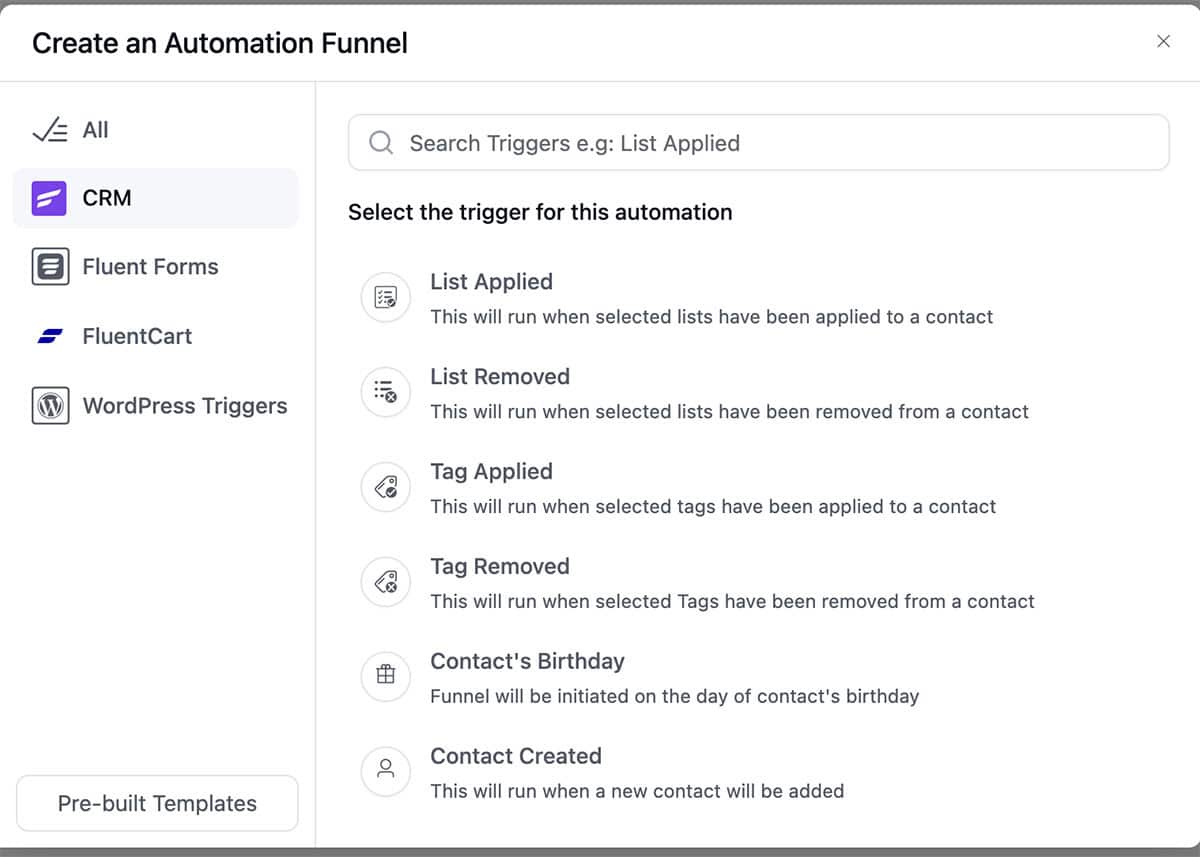
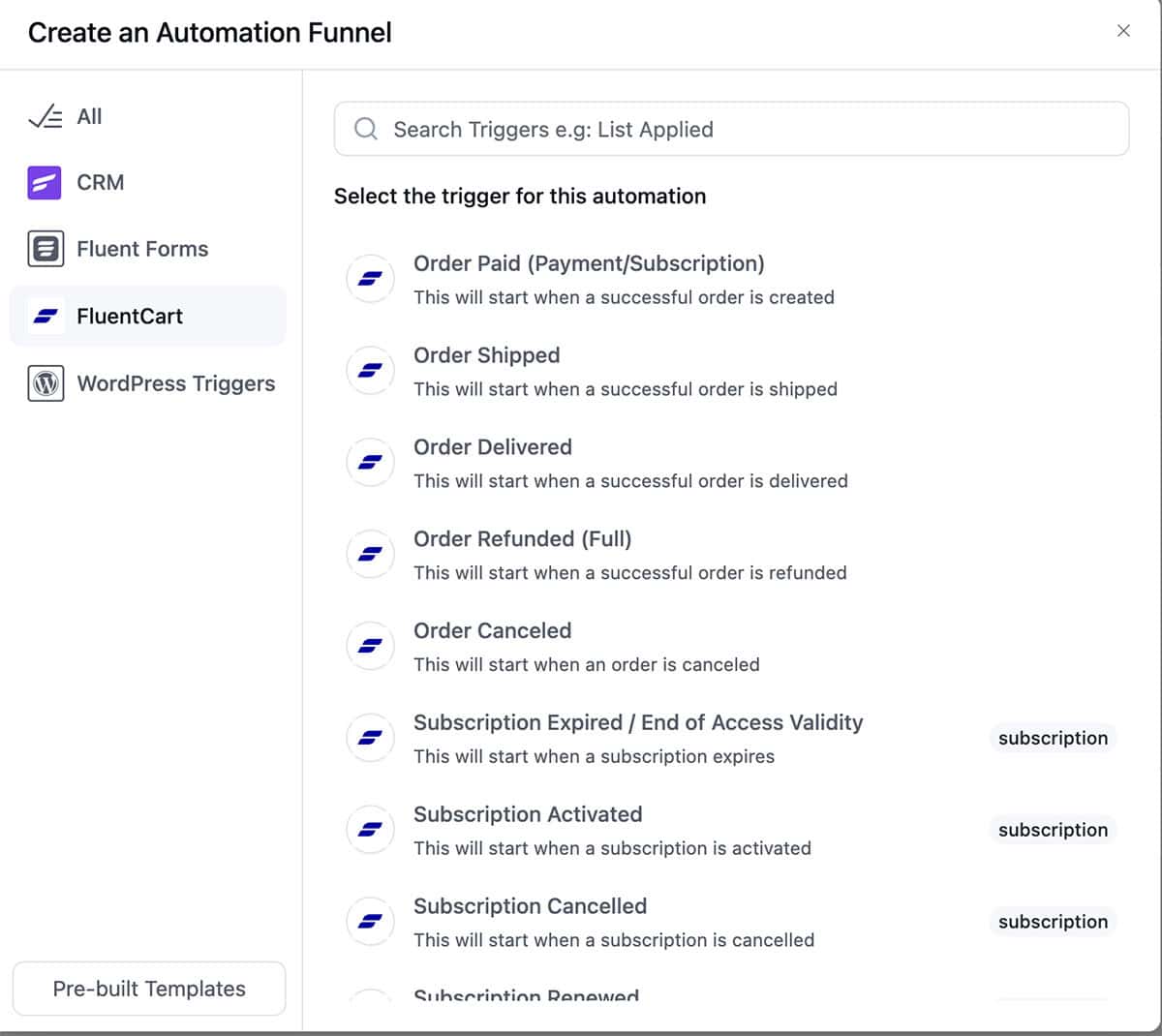
The version 3.0 interface introduces a refined process for initializing workflows. The system now utilizes a series of intuitive panels to define how the engine reacts to specific data events. This streamlined configuration is a significant improvement over previous versions, making it easier to map complex business logic to real-world actions.
Decoupling Campaigns and Sequences
While the automation engine handles the background logic, the system provides distinct tools for manual and scheduled communication. This separation ensures that your operational intelligence remains organized and manageable:
By consolidating these functions into a single logic engine, you eliminate the fragmentation that plagues most marketing stacks. You are no longer managing separate islands of data; you are operating a unified system where every action informs the next automated response.
Data Residency and Compliance Sovereignty
In the SaaS model, your customer database is a guest on someone else’s infrastructure. This creates a compliance liability that businesses often attempt to solve with complex legal addenda. By moving the CRM into a self-hosted environment, you shift from managing liabilities to exercising total data sovereignty.
The Residency Advantage
Data residency is the cornerstone of modern digital privacy. When your lead and customer data live within your own firewalled database, you eliminate the risks associated with multi-tenant cloud environments:
Native Data Governance
Because FluentCRM utilizes custom database tables within your WordPress installation, the data is structured for high-speed retrieval without the bloat of standard post-meta queries. This enables deep segmentation and behavioral tracking that occur entirely on-premises.
This architectural choice ensures that your marketing intelligence is a permanent business asset. You are no longer renting access to your own customer relationships; you are the sole custodian of the data that drives your revenue.
Hardware Requirements and Infrastructure Scaling
Marketing automation local to the data requires more than a standard shared hosting environment. To maintain the zero-latency responsiveness of the Vue 3 interface and handle background email processing, you must provide adequate hardware resources.
The Infrastructure Bottom Floor
For a reliable production environment, I recommend a Virtual Private Server (VPS) as the absolute minimum entry point. Attempting to run this stack on shared hosting will result in database lockouts and timed-out processes. Your baseline specifications should include:
Scaling for Growth
As your contact list grows into the hundreds of thousands, your infrastructure must scale accordingly. Unlike SaaS, where you pay per subscriber, here you only pay for the raw compute power. If your database queries begin to slow, you simply upscale your VPS resources. This remains significantly more cost-effective than SaaS tenant fees, as you are paying for actual hardware performance rather than a vendor’s arbitrary pricing tier.
To simplify the management of this high-performance stack, I utilize xCloud for my managed hosting infrastructure. It provides a control panel that makes deploying and scaling a 4GB VPS as simple as standard shared hosting, but with the dedicated resources required for a zero-latency CRM engine. You can learn more about my infrastructure setup here: xCloud VPS Hosting.
The Success Tax ROI
In a typical SaaS environment, growth is penalized. As your list expands, your monthly subscription increases regardless of your actual revenue. This is the Success Tax. To evaluate the true return on investment (ROI) of FluentCRM, we must look at the long-term total cost of ownership (TCO) compared to the industry standard.
Eliminating Growth Penalties
When you own the infrastructure, the cost of scaling your audience is decoupled from your CRM license. This creates a massive financial advantage as your business matures:
The Inflection Point
There is a specific moment in every online business where SaaS costs begin to cannibalize profit margins. For most, this happens once the list exceeds 10,000 subscribers.
By implementing the Sovereign Stack early, you lock in your operational costs. The money saved on monthly tenant fees can be redirected into lead generation or product development. In this context, FluentCRM is not just a marketing tool; it is a profit-preservation engine.
The Decision Framework
Before you make a decision about FluentCRM, you need to understand whether you’re actually in the right position to use it. This isn’t a feature comparison problem. This is a fit assessment problem.
The question isn’t whether FluentCRM has features. It does. The question is whether you’re ready to operate as your own infrastructure architect, and whether the financial model makes sense for your business at this stage of growth.
The Right Fit: When FluentCRM Wins
FluentCRM is genuinely right for you if you’re in one of these four situations.
Scenario 1: You’ve Outgrown the Pricing Tiers
You’re currently paying between $500 and $3,000 per month for a SaaS email platform. Every time your list grows by 5,000 subscribers, your bill climbs another tier. You’ve done the math and realized that at your current growth rate, you’ll be paying $1,500 per month in two years, and $2,500 per month in four years.
You’re not unhappy with the features. You’re unhappy with the financial model punishing your own success.
If this is you, FluentCRM solves an actual problem. Your investment in infrastructure ($50 per month for hosting) replaces an exponential cost curve with a fixed cost. By the time you reach 100,000 subscribers, you’ll have saved tens of thousands of dollars. That money can fund growth, not vendor fees.
Scenario 2: You Need Deep Integration With Your WordPress Stack
You run a business that depends on seamless data flow between your email system, your commerce platform, your community, and your courses. Right now, you’re using Zapier to bridge the gaps. You have 20 to 50 automation workflows, and you spend hours maintaining them when APIs change or integrations break.
You want your email automations to respond in real time when someone buys a product, completes a course, or participates in your community. You don’t want to wait for webhooks and API syncs.
FluentCRM solves this by living inside your WordPress environment. It triggers automations instantly when database events occur. You eliminate the Zapier dependency and the latency tax that comes with it. Your marketing engine becomes truly integrated with your business infrastructure.
Scenario 3: You Want to Own Your Customer Data
You’ve watched SaaS platforms get acquired, shut down features, change pricing models, and lock users into proprietary ecosystems. You’ve decided you want to own your customer database completely. You don’t want your lead and subscriber data living on someone else’s servers, subject to their terms of service.
You’re willing to manage your own server because you understand that control requires responsibility.
FluentCRM solves this by keeping your entire customer database on your own infrastructure. You own the data. You own the business logic. You own the automation rules. If FluentCRM development stopped tomorrow, your data and automations would continue to run. You’re not a tenant anymore.
Scenario 4: You’re Building Systems That Require Speed and Reliability
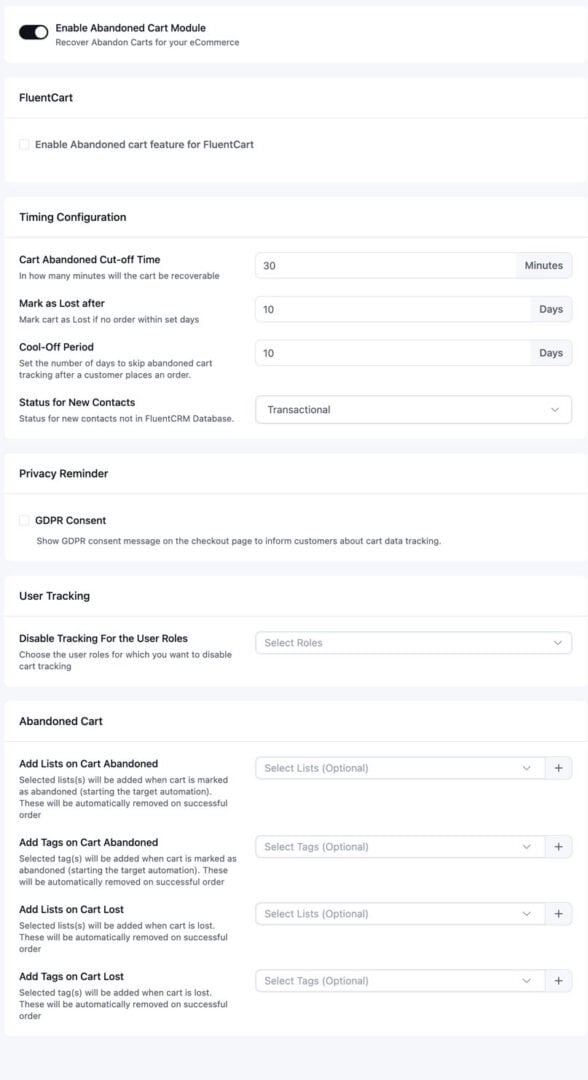
You’re running a sophisticated business operation where automation speed matters. You have abandonment cart workflows that need to fire within seconds. You have conditional logic that checks multiple data points before sending messages. You have high-volume sending periods where your system processes thousands of emails per hour.
A SaaS platform with external API calls creates latency that impacts your results. You need a system in which triggers and actions share the same database, so everything happens instantly.
FluentCRM solves this because it’s engineered for high concurrency on standard VPS hardware. Your automations fire in milliseconds, not seconds. Your database queries execute in under two seconds, even with 100,000 contacts. Your system scales gracefully without requiring enterprise-level infrastructure investment.
The Wrong Fit: When FluentCRM Causes Problems
FluentCRM is the wrong choice if you’re in one of these four situations.
Scenario 1: You Want to Avoid Any Infrastructure Decision-Making Entirely
You want a platform where you never think about infrastructure. You don’t want to choose a hosting provider. You don’t want to monitor performance. You don’t want to make decisions about scaling resources. You want the platform itself to handle all of that invisibly.
Even with a managed hosting provider like xCloud that removes most of the technical burden, you’re still making the decision to use them. You’re still aware that infrastructure exists. Some people find that awareness uncomfortable.
If you want to completely outsource all infrastructure planning and never make a decision about where your data lives, then a SaaS platform is better aligned with your preferences. You can ignore the infrastructure entirely.
Scenario 2: You Need a Vendor to Be Legally Liable for Uptime
You want a platform that guarantees 99.9% uptime with a formal service level agreement and a legal contract stating that the vendor is financially liable if they fail to meet that guarantee.
When you use a self-hosted platform on a managed VPS, you have a contract with your hosting provider for their uptime. But the email marketing platform itself is your responsibility. If FluentCRM has a bug that crashes your automations, there’s no vendor SLA protecting you.
Some businesses require vendor accountability as a legal matter. If your business operations depend on a contractual safety net tied to a single vendor, then SaaS with formal SLAs is what you need.
Scenario 3: You Use a Third-Party System With Zero Integration Capability
Your business depends on a platform that has no API, no webhooks, and no way to connect to external systems. You need your email system to exchange data with this platform, but there is no technical way to do so.
FluentCRM has native integrations with major WordPress platforms. It has an API and webhooks. It supports Zapier. It can connect to external services through multiple channels. For nearly any third-party platform, you have at least one path to integration.
If you depend on a platform with genuinely zero integration capability, then email marketing integration won’t work regardless of which platform you choose.
Scenario 4: You Believe the Financial Case for SaaS Is Stronger Than Self-Hosted
You’ve calculated your costs and believe that a SaaS platform is financially superior to self-hosted for your specific situation.
This is rare, but it’s possible. If your list is small (under 5,000 subscribers) and a SaaS platform offers a free or very cheap tier, the cost advantage of self-hosting disappears. You’d be spending $50 per month on hosting to save $0 per month on SaaS fees.
Do the math for your specific list size and growth trajectory. If SaaS genuinely wins financially, that’s a valid reason to choose it.
But understand what you’re choosing: lower costs for convenience now, against higher costs as you grow. Most businesses eventually reach a point where the growth penalty makes SaaS expensive. Starting with SaaS means you’ll eventually face the migration pain we’ve discussed.
If you know your financial situation and you’ve chosen SaaS with eyes open, that’s a legitimate decision.
Three Questions You Must Answer First
Before you commit to FluentCRM, honestly answer these three questions. Your answers will determine whether this platform is actually right for you.
Question 1: Are You Willing to Make an Infrastructure Decision?
Not to manage servers yourself. A managed hosting provider like xCloud handles that. But you need to be willing to choose a hosting provider and make it part of your business infrastructure.
This is a one-time decision. You choose a provider, set up your account, and most of the infrastructure management becomes invisible. It’s not like you’re SSH-ing into servers daily.
If you’re willing to make that choice and trust a managed hosting provider to handle the technical layer, answer yes.
If you want to avoid any infrastructure decision entirely and prefer a SaaS vendor to handle everything, answer no.
If you can answer yes to this question, move to the next one. If you can answer no, SaaS is more aligned with your preference.
Question 2: Do You Want to Avoid the Migration Pain Later?
Here’s the hard truth about starting with SaaS. As your business grows and your email operation becomes more sophisticated, SaaS costs escalate. At some point (usually around 10,000 to 50,000 subscribers), the monthly fees become significant enough to make you consider migration.
Then you face the migration pain. Your automations are tied to SaaS interfaces and proprietary logic. Your data is in their format. Your integrations depend on their API. Extracting all of that and rebuilding it on a different platform takes weeks or months.
If you start with FluentCRM from the beginning, you never face that pain. Your automations and integrations exist in an open environment. If you ever want to move, you can. If you want to expand capabilities, you can. You’re not locked in.
Some people prefer to start with SaaS simplicity and accept the migration pain if growth happens. Others prefer to start with a platform that scales with them and eliminates lock-in.
Which approach aligns with your business philosophy?
Question 3: Are You Ready to Be the Architect of Your Own System?
This is the real question. Everything else is logistics.
When you use FluentCRM, you’re not a customer in the traditional sense. You’re the operator. You’re making architectural decisions. You’re thinking about how different components interact. You have control over your systems.
Some people love this. They want control. They want to understand their systems deeply. They want to optimize and improve. They want to own their business infrastructure.
Some people dislike this. They want to delegate systems to a vendor. They want to focus entirely on marketing and selling. They want someone else to think about infrastructure.
Neither answer is wrong. But you need to know which one applies to you.
If you’re ready to be the architect of your own system, FluentCRM will feel like a massive upgrade. You’ll have more power, more control, and significantly lower costs as you scale.
If you’d rather delegate infrastructure to a vendor, no amount of features will make FluentCRM satisfying. The control and responsibility will feel like a burden.
The Core Decision
FluentCRM is not better than SaaS email platforms. It’s different. It trades convenience for control. It trades vendor management for infrastructure management.
The decision isn’t whether FluentCRM is superior. The decision is whether you want the trade-off.
If you’ve read this far and answered yes to all three questions, proceed with confidence. FluentCRM is designed for people like you.
If you’ve answered no to any of them, save yourself the friction. Use a SaaS platform. There’s no shame in that. You’re choosing the tool that fits your situation.
The worst outcome is choosing the wrong tool for the wrong reasons, then spending six months frustrated by the mismatch between your needs and the platform’s design philosophy.
Choose deliberately. Choose for the right reasons. Choose because the fit is genuinely right, not because someone convinced you that self-hosted is always better.
Why You Actually Need to Read This Whole Article
This is why I structured this review to require you to read beyond a summary. A single verdict or a feature table cannot capture what FluentCRM actually offers, because what it offers is not a feature. It is a different way of thinking about your business infrastructure.
The sections that follow will show you how the Vue 3 rewrite eliminated the administrative latency that plagued earlier versions. You will understand why event-driven automation (where triggers and actions share a database) fundamentally changes what is possible. You will see what it actually costs to own your infrastructure versus renting it. And you will learn who this is genuinely right for, and more importantly, who it is wrong for.
But none of those sections will matter until you understand the core question: Do you want to be a tenant paying for convenience, or an owner managing your own infrastructure?
Everything else flows from that one decision. Every feature, every benchmark, every technical detail builds on this foundational choice.
Implementation Reality
The decision to move to FluentCRM is straightforward. The implementation is where reality meets expectations. This section walks you through what actually happens, how long it takes, and where most people stumble.
The Setup Timeline: Week by Week
Your first month determines whether you build momentum or get frustrated. Here’s what a realistic implementation looks like.
Week 1: Foundation and Migration
The first week focuses on getting your infrastructure in place and moving your existing data.
You select a managed hosting provider (if you haven’t already) and provision a 4GB RAM VPS. This takes 30 minutes to two hours, depending on the provider. xCloud, for example, has a control panel that’s superior to cPanel, so setup is straightforward.
You install WordPress and FluentCRM on your new server. If you’re migrating from an existing WordPress installation, you clone your site or restore from a backup. This takes two to six hours, depending on your site size and your comfort with backups.
You import your subscriber list from your previous email platform. This is where most people encounter their first surprise. Your old platform likely has data in formats that don’t perfectly map to FluentCRM’s schema. Email addresses import cleanly. Custom fields often need mapping. FluentCRM does a remarkably good job importing Tags from other services. All of my Kit (ConvertKit) tags imported without fail.
Budget eight to twelve hours for this import and data cleanup. If you have 100,000 subscribers and complex custom fields, budget more.
By the end of Week 1, you will have a working FluentCRM installation with your subscriber data imported. Your automations don’t exist yet. Your email sending is not yet configured. But the foundation is solid.
Time investment: 12 to 24 hours
Week 2: Email Delivery and Basic Configuration
The second week focuses on connecting your email delivery infrastructure and configuring the CRM for basic operation.
You choose an SMTP provider (Amazon SES, Postmark, Mailgun) and configure FluentCRM to send through it. This takes one to two hours. You’ll send test emails and verify deliverability. You’ll set up SPF and DKIM records for your domain. This takes another hour or two if you’re familiar with DNS, or four to six hours if you’re not.
You configure your subscriber preferences and unsubscribe pages. You set up your default email footer. You configure compliance settings for GDPR and CAN-SPAM. This takes one to two hours.
You create your basic tag structure. FluentCRM uses both Lists and Tags, so you can choose the subscriber segmentation model that you prefer.
By the end of Week 2, your email delivery infrastructure is working. You can send broadcasts. Your subscribers can manage their preferences. But you still don’t have automations running.
Time investment: 10 to 18 hours
Week 3: Automation Setup
The third week is where the real power emerges. You build your first automations.
Most people start with simple automations: a new subscriber welcome sequence, a form submission automation, and a cart abandonment automation if you’re using FluentCart or WooCommerce. Each automation takes two to four hours to build, test, and deploy.
You rebuild your most important workflow first. You test it thoroughly. You monitor the logs. You verify that emails are sent, triggers fire, and tags apply correctly.
You likely encounter a mistake here. Maybe your conditional logic is wrong. Maybe a tag is misspelled. Maybe you forgot to add a delay between emails. This is normal. You debug, fix, and move forward.
By the end of Week 3, you have three to five automations running. They’re working, but you’re still learning the interface and the logic patterns.
Time investment: 12 to 20 hours
Week 4: Expansion and Refinement
The fourth week is about expanding to full functionality and starting to optimize.
You rebuild your remaining automations. You set up behavioral triggers based on site activity, form submissions, and product purchases. You integrate with your ecommerce platform if you have one.
You notice that certain automations could be improved. You refine the copy. You adjust the timing. You add conditional logic to avoid sending messages to people who have already taken the desired action.
You start to see the benefits. Your automations trigger instantly instead of on a delay. You have full visibility into what’s happening. You can modify workflows without waiting for a vendor to push an update.
By the end of Week 4, you have a functional marketing automation system. It’s not perfect, but it’s working and improving continuously.
Time investment: 16 to 24 hours
Total first month: 50 to 86 hours
This breaks down to roughly 12 to 21 hours per week. Some people compress this into 10 intensive days. Others spread it over the full month while continuing normal work.
Common Mistakes and How to Avoid Them
Most people who migrate to FluentCRM make similar mistakes. Knowing them in advance prevents frustration.
Mistake 1: Recreating Your Entire Workflow Immediately
You’re excited about FluentCRM’s power. You decide to rebuild all 50 of your existing automations in the first week.
This creates two problems. First, you spend 100+ hours rebuilding instead of 50 hours phasing in. Second, you’re learning the interface while managing a massive project. You make mistakes faster than you can fix them.
Better approach: Migrate your three most important automations first. Get them working perfectly. Then gradually add the others. You learn at a sustainable pace while your most critical workflows are secure.
Mistake 2: Not Mapping Your Old Data Correctly
Your previous platform had fields like “Lead Source,” “Customer Status,” and “Engagement Level.” FluentCRM doesn’t have those fields built-in. You need to decide whether to recreate them as custom fields, as tags, or as a combination.
Most people make this decision wrong the first time, then spend hours cleaning up.
Better approach: Before you import, map out your data structure. Document which old fields become custom fields, which become tags, and which you can retire. Import once with confidence instead of importing twice with corrections.
Mistake 3: Overcomplicating Your First Automations
You build an automation with seven conditions, three nested branches, and five actions. You test it, and nothing works. You spend hours debugging.
The problem isn’t FluentCRM. You built something too complex while learning the interface.
Better approach: Your first automation should be simple. New subscribers receive a welcome email after five minutes. That’s it. Get it working. Then add complexity gradually. Better yet, create atomic automations that do one thing, then initiate another automation to handle the next task. That makes the services reusable without having to recreate them across multiple automations.
Mistake 4: Not Setting Up Your Email Delivery Provider Correctly
You choose Amazon SES and configure it in FluentCRM. You don’t realize you need to request production access from Amazon first. You send a test email, and it bounces.
Or you set up SPF and DKIM records incorrectly, and your emails end up in spam.
Better approach: Before you do anything else, choose your SMTP provider and configure it correctly. Test sending multiple emails to multiple addresses. Verify they arrive in inboxes, not spam folders. Only then move to other setup tasks.
Mistake 5: Not Testing Your Automations Before Going Live
You build an automation and immediately activate it on your live list. You assume it’s working. Three days later, you discover it’s sending the wrong email to the wrong people.
Better approach: Create a test tag. Add yourself and a few colleagues to it. Trigger your automation and verify it works exactly as intended. Only then activate it on your full list.
Mistake 6: Changing Too Much at Once
You migrate to FluentCRM and decide to restructure your entire email strategy at the same time. New welcome sequence. New tag structure. New broadcast schedule.
You’ve introduced too many variables. If something goes wrong, you can’t identify the cause.
Better approach: Keep everything the same except the platform. Migrate your existing workflows first. Once they’re stable, then start improving and optimizing.
Learning Curve by User Type
Different people learn FluentCRM at different speeds. Your timeline depends on your background.
WordPress Admin Familiar With Plugins
You understand WordPress. You know how plugins work. You’re comfortable in the WordPress admin.
Timeline to confidence: 1 to 2 weeks
FluentCRM integrates with WordPress natively. The interface follows WordPress conventions. You understand database tables and custom fields conceptually. You’ll feel comfortable within days.
Your first week is productive. You’ll build basic automations by day five. You’ll have a working system by day ten.
Non-Technical Business Owner
You run a business. You know email marketing conceptually. You’re not afraid of software, but you’re not a technical person.
Timeline to confidence: 2 to 4 weeks
You’ll spend more time learning the automation builder. The concepts of triggers, conditions, and actions will take time to internalize. Email delivery infrastructure (SMTP providers, DNS records) will feel foreign initially.
You’ll benefit from following the setup timeline exactly as written. Each week builds on the previous one. By week four, you’ll understand how everything connects.
Developer or Technical Person
You understand databases, APIs, webhooks, and server architecture.
Timeline to confidence: 3 to 5 days
You’ll skim the documentation. You’ll build your first automations immediately. You’ll notice architectural decisions and think about optimization. You’ll probably want to integrate with custom development or n8n workflows.
Your only limitation is the initial learning of the specific FluentCRM interface and conventions. Once you learn those, you’ll move quickly.
When to Expect Real Results
Implementation is only meaningful if you see actual results. Here’s when different types of results become visible.
Email Delivery Working Correctly (Week 1-2)
You send a broadcast email. It arrives in inboxes. This happens immediately. Within the first one to two weeks, you’ll confirm that your email delivery is working reliably.
This is the baseline. If this isn’t working by week two, something is wrong with your SMTP setup and needs troubleshooting.
Automations Triggering Correctly (Week 2-3)
You build an automation and watch it run. Triggers fire. Emails send. Tags apply. This is visible within two to three weeks.
You’ll see in the automation logs exactly what’s happening. Each subscriber action is recorded. You have complete visibility into your automation behavior.
Performance Improvements Noticeable (Week 3-4)
If you came from a SaaS platform with external API calls, you’ll notice that FluentCRM feels faster. Dashboard navigation is instant. Reports load quickly. Bulk operations complete in seconds instead of minutes.
These improvements become obvious once you’re actively using the system.
Cost Savings Visible (Month 2)
The first month, you’re still paying for your old SaaS platform (you probably want to run both in parallel during migration). In month two, you cancel the old platform, and the cost difference becomes clear.
If you were paying $500 per month for SaaS and now you’re paying $50 for hosting, you see a $450 monthly savings immediately.
List Growth Without Cost Increase (Month 3+)
The real FluentCRM advantage becomes visible over time. Your list grows. Your SaaS costs would have increased. Your FluentCRM costs stay fixed.
By month six, if your list has grown 50 percent, the financial advantage is substantial. By month twelve, if you’ve doubled your list, the SaaS cost would be twice as high, while your FluentCRM cost remains unchanged.
Managing Expectations During Implementation
Implementation is productive but not glamorous. You’re spending time on infrastructure instead of marketing. This feels backward until you realize it’s setting up your entire future.
Most people hit a frustration point in week two or three. Setup is tedious. Automations aren’t building as fast as you hoped. Your old system’s data doesn’t import perfectly.
This is normal. This is the part where self-hosted infrastructure requires your attention, rather than your old vendor handling it for you.
Push through this week. By week four, you’ll have momentum. You’ll see things working. You’ll understand the system. The investment will feel justified.
The people who succeed at FluentCRM migration are the ones who expected this timeline and pushed through week two. The people who struggle expected to flip a switch and have everything working immediately.
You now know better. Plan for four weeks. Budget 50 to 86 hours. Build incrementally. Test thoroughly. By the end, you’ll have a system that’s faster, cheaper, and more reliable than what you came from.
Does FluentCRM offer a lifetime deal?
The Success Tax of monthly subscriptions is exactly what FluentCRM is engineered to eliminate. While the developers occasionally offer promotional pricing during major version launches, such as the 3.0 Beta, the standard model is an annual license. This provides a predictable, fixed-cost infrastructure that lets you scale your contact list to infinity without the financial penalties associated with SaaS platforms like MailChimp or ActiveCampaign.
How does FluentCRM compare to MailChimp?
MailChimp operates on a digital tenancy model where you rent access to your own data and pay higher rent as your business grows. Architecturally, FluentCRM is a self-hosted engine that sits on your own property. Beyond the massive cost savings, the primary difference is performance and integration. Because FluentCRM triggers automations instantly based on site activity, you remove the latency inherent in API handshakes between disconnected third-party servers.
Can I try a FluentCRM demo before purchasing?
You can install a free version of FluentCRM directly from the WordPress repository to verify the interface and core features without a time limit. Because the developers do not provide a sandbox environment, I recommend installing the free version on a staging or development site. This allows you to audit the performance and test the Vue 3 framework within your own server environment before committing to a Pro license.
Does FluentCRM slow down WordPress performance?
FluentCRM avoids the bloat and performance degradation typical of legacy plugins by bypassing standard WordPress tables. The entire Fluent Stack creates and maintains its own dedicated database tables to ensure surgical speed. While the software is highly efficient, its ultimate performance depends on your infrastructure. I recommend a VPS with at least 4 GB of RAM and 2 vCPUs as the minimum resource requirement to ensure zero-fail automation.
Is FluentCRM a standard WordPress plugin?
It installs via the WordPress dashboard but functions as a deep system integration. The 3.0 rewrite uses Vue 3 to ensure marketing operations do not interfere with your front-end user experience. By housing your data in dedicated tables on your own server, you maintain absolute data sovereignty and ensure your operational engine remains fast and responsive as your database expands.